5
mins

Hearing damage often develops gradually and goes unnoticed. However, by the time an employee starts experiencing symptoms, the damage is usually permanent. That is why European legislation sets strict requirements for hearing protection used in the workplace. EN 352-2 is the standard that sets the benchmark specifically for earplugs and custom-molded earplugs, with EN 352-2:2020 being the latest version. In this article, we explain what this standard entails, who it applies to, and why it is relevant when choosing custom-molded earplugs.


EN 352-2 is part of the broader EN 352 group of standards. This group describes the general requirements and test methods for all types of hearing protection and was developed by the European technical committee CEN/TC159. EN 352 itself does not specify a product type. EN 352-2 is the part that focuses specifically on earplugs and custom-molded earplugs.
The most current version of this standard is EN 352-2:2020. A transition period applied to products brought to market before the revision. That period has now ended. Products sold as hearing protection today must therefore fully comply with this version.
Certification according to EN 352-2 means that a product has been tested by an independent, accredited laboratory and assessed by a notified body. This party verifies that the product meets the requirements of Regulation (EU) 2016/425 for personal protective equipment. Only after approval may a product bear the CE mark.
For custom-molded earplugs this is especially relevant. Because each pair is custom-fitted to the user's ear canal, not only the material but also the production process must be demonstrably reliable. Certification according to EN 352-2:2020 provides certainty in this regard. It demonstrates that the product provides the attenuation stated on the packaging in practice, and not just in a laboratory setting under ideal conditions.
The obligations regarding hearing protection are described in Chapter 6 of the Working Conditions Decree. Articles 6.6 through 6.11 outline what an employer must do based on noise levels.
At an average noise level of 80 dB or more per day, an employer must make hearing protection available to employees exposed to that noise. From 85 dB, this changes from an offer into an obligation. Employees are then required to actually wear the provided protection. Exposure must not exceed 87 dB. An employer who maps these levels via the RI&E knows exactly when each obligation applies.
In addition to providing suitable protection, this also includes training. Employees must know why hearing protection is necessary and how to use it correctly. For custom-molded earplugs, this also means periodic checks (leak tests), as the shape of the ear canal can change over time.
Universal earplugs offer fixed attenuation and are suitable for short-term or occasional use. For employees who work in a noisy environment every day, this is not always the best choice. An earplug that does not fit properly provides less attenuation than stated on the packaging, even if the product itself is certified according to EN 352-2.
Custom-molded earplugs are shaped to the user's ear canal. As a result, they fit better, remain comfortable for longer, and the risk of incorrect use is lower. For employers who structurally deal with noise levels above 80 dB, this is often the most effective solution, even in the long term.
When choosing hearing protection, it is wise to look beyond just the noise level or the price. Certification according to EN 352-2 is a concrete checkpoint. Always ask a supplier for the test report and the declaration of conformity, and check whether they refer to EN 352-2:2020. This ensures that the protection you provide to employees does what is required.
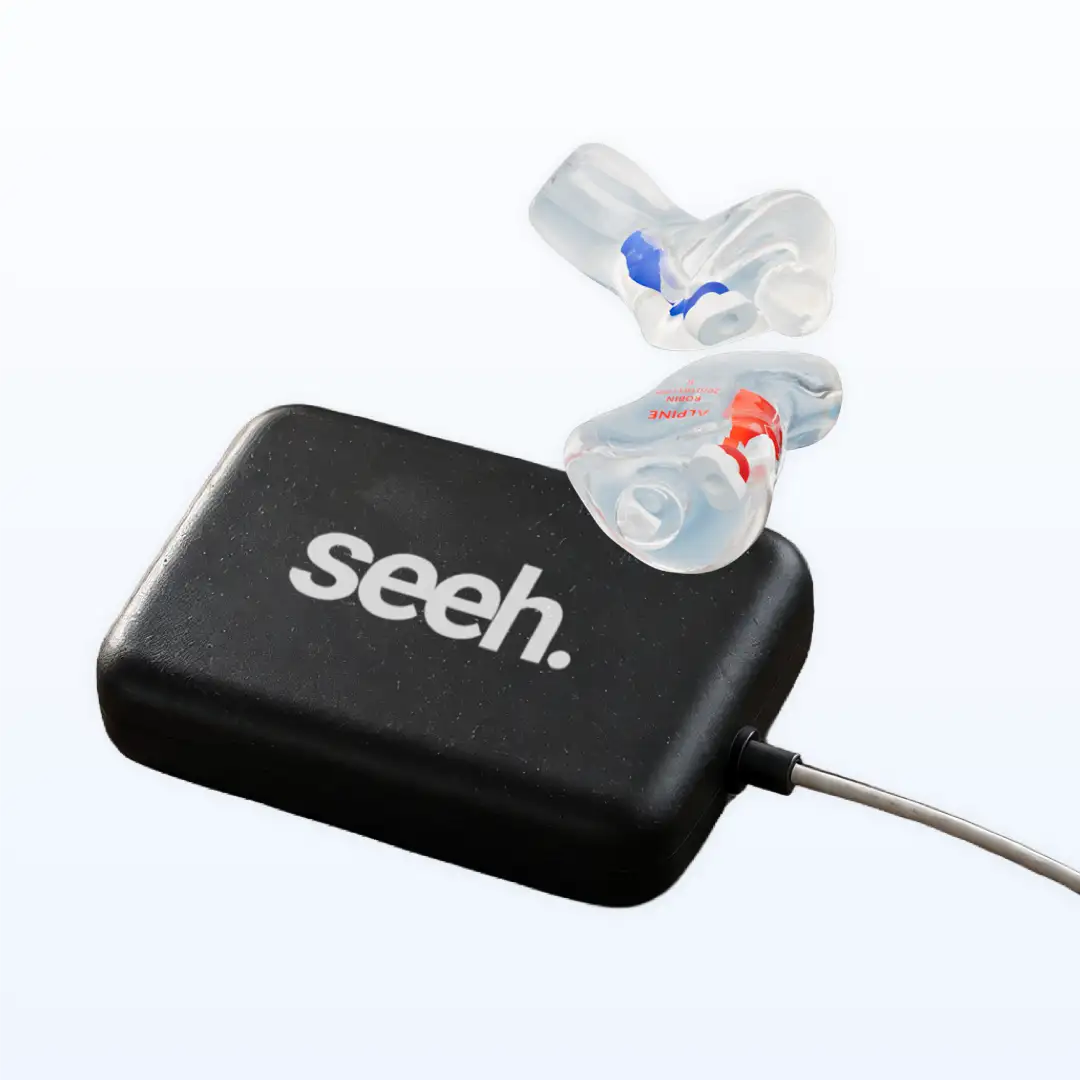
At Seeh, we provide our custom-molded earplugs in partnership with Alpine, one of the leading brands in the hearing protection market. All custom-molded earplugs you order through Seeh, are certified according to EN 352-2:2020. This ensures that every earplug fitted for your employees meets the latest European standards, regardless of the model you choose.

EN 352 is the name of the complete set of standards for hearing protection, with separate parts covering items such as earmuffs and helmet-mounted protection. EN 352-2 is the specific part of that group that addresses earplugs and custom-molded earplugs. Therefore, if you are looking for information on in-ear hearing protection, EN 352-2 is the only standard you need.
Not always. For small products like earplugs and custom-molded earplugs, there is often no room for this. In such cases, the marking, along with the CE marking, is placed on the smallest packaging or in the provided instructions. For reusable earplugs and custom-molded earplugs, additional markings on the product itself depend on the brand, such as color-coding for the left and right ear. The only requirement is that the standard and the CE marking can be found somewhere, allowing you to verify that the product has actually been tested and approved.
As an employer, you are required to provide hearing protection if the average daily noise level reaches 80 dB. Once levels reach 85 dB, the use of hearing protection becomes mandatory for employees.
Article by
With more than 20 years of experience, Seeh is your partner in eye and hearing protection. Together with Hans Anders, we easily help companies in the Netherlands and Belgium find customized eye and hearing protection. With our solutions, you ensure that your employees can always work safely and comfortably.
Deel dit artikel met je collega's


.svg)